If you’ve just finished SPM and keep hearing the term “SKM” thrown around at TVET fairs, career talks, or by friends who’ve chosen a vocational route — you’re not alone in wondering what it actually means, and whether it can genuinely take you somewhere.
For thousands of Malaysian school leavers every year, SKM Malaysia (Sijil Kemahiran Malaysia) is the certification that turns hands-on training — whether that’s in a working kitchen like Operasi Seni Kulinari or on an engineering floor like Kejuruteraan Automasi — into a recognised, employable qualification. Here’s what it is, how it works, and why it matters for your next step after SPM.
Key Takeaways
- SKM (Sijil Kemahiran Malaysia) is Malaysia’s national skills certification, issued by the Jabatan Pembangunan Kemahiran (JPK) under the Ministry of Human Resources.
- SKM is built on five progressive levels — SKM 1, SKM 2, SKM 3, Diploma Kemahiran Malaysia (DKM), and Diploma Lanjutan Kemahiran Malaysia (DLKM) — each mapped to the Malaysian Qualifications Framework (MQF).
- Every SKM qualification is based on a National Occupational Skills Standard (NOSS), meaning the syllabus is built directly from industry requirements, not just classroom theory.
- JPK recognition means your certificate is verifiable nationally and accepted by employers, government agencies, and further education providers.
- SKM is a genuine alternative — not a lesser one — to the academic pathway, with its own progression route all the way up to degree-equivalent levels.
- Choosing a registered TVET provider, like Noble School, ensures your training actually leads to a certified, JPK-recognised SKM outcome.
Vocational education in Malaysia has shifted significantly in the past decade, moving from a “backup option” perception to a genuinely competitive route into skilled careers — one that programmes like Pembuatan Roti at Noble School City Campus (NSCC) are built around. Understanding how SKM fits into that shift is the first step to deciding if it’s right for you.
What Is SKM (Sijil Kemahiran Malaysia)?
SKM, or Sijil Kemahiran Malaysia, is Malaysia’s official skills certification awarded to individuals who complete competency-based vocational training in a recognised occupational field. It is issued by the Jabatan Pembangunan Kemahiran (JPK), also known as the Department of Skills Development, a body under the Ministry of Human Resources responsible for setting and certifying skills standards nationwide.
Unlike a standard academic certificate that measures what you know through exams, SKM measures what you can do — your ability to perform real tasks to an industry-defined standard. This is why SKM training is typically hands-on and practical, delivered through registered institutions known as ILKS (Institut Latihan Kemahiran Swasta), such as Noble School City Campus (NSCC) and Noble School of Engineering (NSE).
What is a NOSS, and why does it matter?
Every SKM programme is built around a National Occupational Skills Standard (NOSS) — a benchmark developed with input from industry players in that specific field. In practical terms, this means a student earning an SKM in, say, culinary operations or automation engineering is being trained against the same skill expectations that employers in that industry actually use to hire and promote staff.
How SKM Levels Work: From SKM 1 to DLKM
SKM isn’t a single qualification — it’s a structured ladder with five levels, each one building on the last:
Level | Qualification | Typical Entry Requirement | MQF Level |
|---|---|---|---|
1 | SKM Level 1 | PT3 or equivalent | 1 |
2 | SKM Level 2 | SKM 1 or PT3 | 2 |
3 | SKM Level 3 | SPM or SKM 2 | 3 |
4 | Diploma Kemahiran Malaysia (DKM) | SKM 3 | 4 |
5 | Diploma Lanjutan Kemahiran Malaysia (DLKM) | DKM | 5 |
Each level corresponds to a position on the Malaysian Qualifications Framework (MQF) — the same framework used to benchmark diplomas and degrees — which is part of why SKM holders can progress academically, not just vocationally. DKM, for example, sits at a supervisory skill level, while DLKM focuses on advanced technical and team-leadership capability.
Exact entry requirements and programme durations can vary slightly between fields and providers, so it’s always worth confirming the specific pathway directly with your chosen institution before enrolling.
Why JPK Recognition Matters for Employability
A skills certificate is only as valuable as the body that stands behind it — and this is where JPK recognition makes the real difference. Because JPK operates under the Ministry of Human Resources and certifies training against standardised NOSS benchmarks, an SKM certificate:
- Can be verified nationally, giving employers confidence it’s genuine
- Is recognised by government agencies and the civil service for relevant technical positions
- Is accepted by private employers across manufacturing, culinary, engineering, automotive, and beauty/aesthetics industries as proof of job-ready competency — fields covered by programmes like Pemasangan & Penyelenggaraan Elektrik Tiga Fasa
- Provides a clear academic progression route, rather than being a dead-end certificate
This is the core difference between training at a registered ILKS and an unregistered short course: only certification through JPK carries this level of national recognition and verifiability.
SKM vs the Academic Pathway: Which Makes Sense for You?
Many SPM leavers feel pressured to choose between “going to university” and “doing a TVET course,” as if one is automatically better. In reality, they serve different goals:
SKM / TVET Pathway | Academic (Diploma/Degree) Pathway | |
|---|---|---|
Focus | Hands-on, job-ready skills | Theoretical and academic knowledge |
Entry | SPM, PT3, or SKM progression | Mostly SPM results-based |
Time to employment | Often faster — practical skills employers can use immediately | Typically longer before entering the workforce |
Progression | SKM → DKM → DLKM → degree-equivalent routes | Diploma → degree → postgraduate |
Best suited for | Students who learn by doing and want early industry exposure | Students aiming for research, management, or academic-heavy careers |
Neither path is “lesser” — a vocational qualification in Malaysia like SKM is increasingly seen by employers as proof of practical readiness, especially in technical fields facing skilled-labour shortages.
How Noble School’s Programmes Lead to SKM
At Noble School, every programme across both campuses is structured to lead toward a recognised SKM (or DKM) outcome, combining classroom fundamentals with real industry-standard practice. Over at Noble School of Engineering, the Kejuruteraan Automotif programme prepares students for Industry 4.0-aligned roles, where automotive systems skills are in increasing demand — while NSCC’s culinary and electrical programmes mentioned earlier build toward SKM assessment in their respective fields.
Because these programmes are delivered through a registered ILKS, the SKM or DKM certification students earn carries full JPK recognition — not just a completion certificate from the school itself.
Choosing the Right SKM Pathway: What to Check Before You Enrol
Is the training provider registered with JPK as an ILKS?
Only registered institutions can issue certification that leads to genuine SKM/DKM recognition.
Which NOSS does the programme follow?
This tells you exactly which skill standard — and therefore which career field — your certificate will be benchmarked against.
What’s the realistic progression route?
Ask whether the programme allows you to continue from SKM toward DKM or DLKM later, rather than ending at a single level.
Does the programme match real industry demand?
Fields like automation, electrical maintenance, culinary arts, and automotive engineering continue to show strong hiring demand in Malaysia, making them practical choices for school leavers weighing their options.
Conclusion: Is SKM the Right Step After SPM?
SKM Malaysia isn’t a fallback option — it’s a structured, JPK-recognised pathway that takes practical skill and turns it into a verifiable, employable qualification, with room to grow all the way to diploma-equivalent levels. For SPM leavers who want to start building real industry competency sooner rather than later, it’s a credible and often faster route into skilled work.
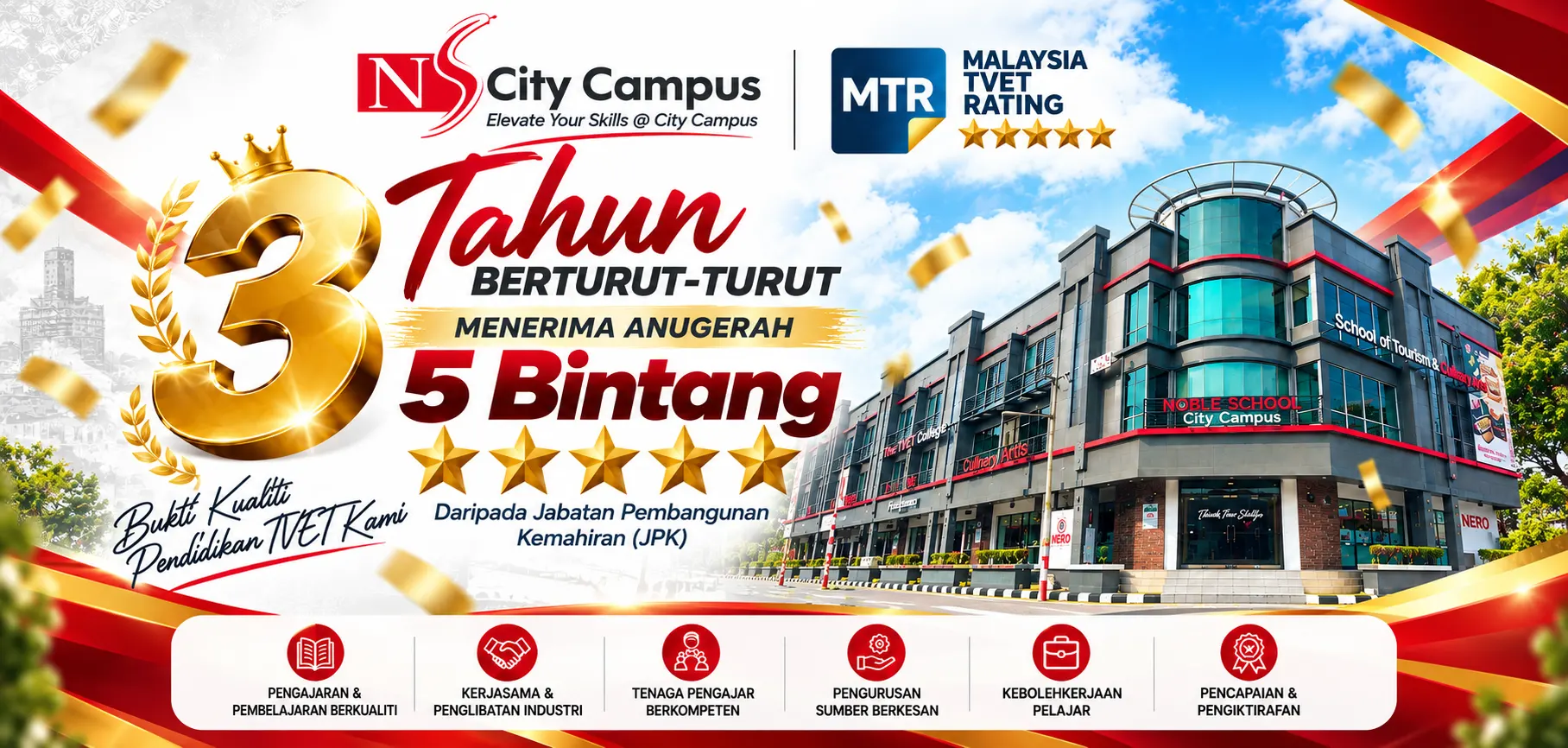
If you’re weighing your options, the Noble School team can walk you through which programme — and which SKM pathway — fits your interests best. Hubungi Kami to speak with our admissions team, or register your interest today to start your TVET journey at a 5 Star TVET college built on industry-standard, hands-on training.
Noble School — Membina Masa Depan Melalui Latihan TVET Bertaraf Industri.